
Meditation that welcomes all of life.
Find uncomplicated presence, leading to spacious clarity and vividness with life as it actually is.
Remain uninvolved with whatever arises.
Our method is simple, and genuinely tricky to learn. Almost everyone misinterprets it at first, each in their own way.
This fully adaptive course will guide you through the learning. Unlike a meditation app with fixed lessons or a book, we adapt to your experience, history, and feedback. Each session is composed around what’s actually happening in your practice.
Most meditation systems are trying to fix you. They suggest you are fundamentally broken.
There is nothing fundamentally wrong with you. A lot of meditation is renunciative: emotions are noise, thoughts are failures, ordinary life is the thing you retreat from. This practice points to another way. You train richer involvement in your ordinary life, not a graceful calm exit from it.
You can remain connected and present in any circumstance, however frightening or exciting it seems. You develop the capacity to hold the intensity, the joy, and the ordinary textures of existence with spacious clarity.
This practice
- Emotions are welcome. All of them.
- No sound is distracting, no thought is bad, no experience is wrong.
- Clarity with connection to people, work, and circumstances.
- Ordinary life is the arena. More of life, not less.
- Leads to being effective without striving.
The renunciate habit
- One more exhausting, effort-based self-improvement project.
- Emotions are obstacles that you have to manage and control.
- Thoughts mean you’re doing it wrong.
- “Letting go,” “non-attachment,” a calm that can become dissociation.
- Meditation as retreat from ordinary life.
It wasn’t until I realized how lonely and frustrating it was for my wife being married to the equanimous, distant version of Jared that I started to wonder if there was a different way to approach my meditation practice.
The course isn’t the same for everyone. We adapt and respond to you personally.
Opening Awareness is more like exploring a wide, varied terrain than following a fixed path. Historically, it was taught teacher to student to ensure adaptability. Your course makes similar adaptations, dynamically steering based on your experience. Each session, which includes teaching and a practice sit, is composed for you following how things are going, where you’re stuck, and what support meets your needs. Underneath it are years of student learning notes and one-to-one instruction.
Unlike normal meditation apps that need you to stay subscribed, we don’t engineer experiences to keep you here. As your practice matures, your confidence will grow. You’ll need the course less. It’s designed to make itself available only when you need it.
Led by Charlie Awbery
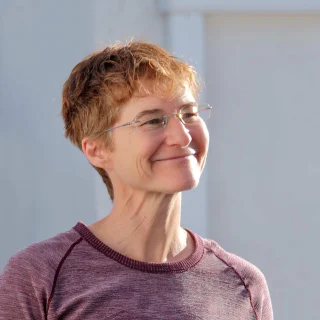
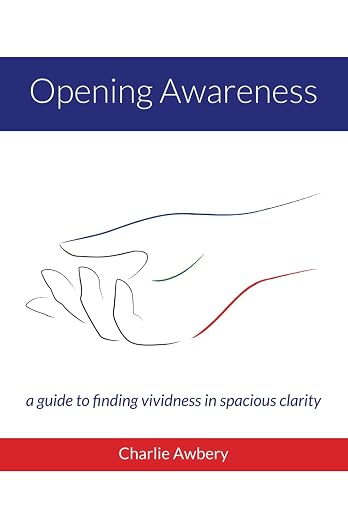
Charlie spent twenty-five years studying, practicing, and teaching Vajrayana, a life-affirming Buddhist path. They cofounded Evolving Ground, a community of contemporary practice, and wrote Opening Awareness (2023), about the meditation this course teaches. These days they also teach this meditation to tech founders and AI researchers operating at the frontier of artificial intelligence.
In the course, Charlie guides with a steady, companionable presence. Sometimes you’ll get clear instruction, or perhaps experiments to try or new things to notice. You get both clear, rooted instruction, and broad context into how this method works. They stay close and responsive, offering simple pointers that help you notice what’s already present.
The method is a contemporary adaptation of a practice with centuries of history in Tibetan traditions. The course is in plain, practical English throughout.
This is a path of celebration, of down-to-earth realism, of uplifting courage, of gentle precision, and of open hearts.
You’ll notice the world getting more vivid
Paradoxically, there’s no special state to chase. As the mind settles, you may experience something like a veil lifting you didn’t know was there: sounds, sights, and sensations grow vivid. You’ll experience:
- Courage to stay present in circumstances you’d usually manage or avoid
- Moments of effortless, quiet awareness in the middle of ordinary activities
- More presence in your interactions, not just while you’re meditating
- Space to hold all your emotions fully without them running you
- General contentedness, punctuated by moments of irrationally exuberant joy
These are common outcomes, though none are guaranteed. Some sits are boring, some are uncomfortable. You’ll include everything in experience. And as with physical practice, the benefits tend to arrive before you feel you’ve accomplished the instructions.
For those who’ve practiced elsewhere: in progressive systems the method is reassuring but the result can be disorienting. Opening Awareness is the opposite. The method can seem elusive at first, and the results are reliable. Practitioners find spacious clarity more consistent and predictable than almost anything else in life.
My practice has shifted from a pursuit of progress to an exploration of awareness itself, filled with freedom, playfulness, and joy, which now permeates both my meditation and my day-to-day life.
 Joe G. — Opening Awareness practitioner
 Opening awareness creates a space of no judgment and total freedom to experience anything that arises. I enjoy that each sit will be uniquely different. I love surprises.
Is this for you?
This will probably suit you if
- You have no consistent practice, having had prior difficulty finding a system that works for you.
- You’ve bounced off meditation apps, not for lack of discipline, but because guided breath number two hundred didn’t seem to be going anywhere.
- You have real experience (perhaps mindfulness, vipassana, many years of sits) and something’s gone dry. Or “equanimity” has started to feel more like distance from the world.
- You keep returning to meditation and then stalling. You want a different approach.
It’s probably not for you if
- You want ten minutes a day of guided calming-down. There are excellent apps for it, but this isn’t one.
- You want the full traditional container: ritual, a teacher relationship in the old form. This is a practical plain-English adaptation.
- You need every sit to feel like progress. Sits can be boring, confusing, or dull. This method takes practice, not more head knowledge.
Questions
What do you mean by “spacious clarity”?
It’s the result of the practice: continuous, vivid appreciation of experience. It’s not blankness or numbness. Practitioners describe it as more room for all of experience.
I’ve never meditated. Can I start here?
Yes. The course assumes no experience, and the first sessions build the foundation: how to sit, what to do with thoughts, how to return. Beginners sometimes have an advantage; there’s less to unlearn.
I already meditate. Will this be remedial?
No. Different systems aim at different results, and this one aims somewhere specific. Don’t buy the platitude that all paths lead to the same goal; empirically, this is not so. Opening Awareness works by release, not concentration, and many practitioners arrive from vipassana, staged approaches, or years of app practice. The first ten days help you recalibrate; you don’t start again from scratch.
Is this religious?
No. The practice descends from a Tibetan lineage: Opening Awareness is a contemporary adaptation of a practice called shi-né. The course is designed for experiment, not belief. Nothing to join, no vocabulary to adopt.
Is this therapy?
No. Meditation and therapy develop different capacities, and this course isn’t a treatment for anything. Opening Awareness can sit well alongside therapy, and many practitioners find it steadying. If you’re in acute crisis or working through trauma, therapy first is often the right order; the course will still be here.
How much time does it take?
You get to choose; consistency matters more than duration. The aim is a meditation that fully fits your real, ordinary life. Missed days are not failure. The course adapts to you rather than scolds.
How long until I notice anything?
Honestly, it varies. With regular practice, many people notice changes in the quality of attention within weeks; understanding the instruction deeply can take a year or more. Day-to-day changes usually show up before the method feels clear. We’d rather undersell this than promise you a schedule.
How are sessions composed?
Every word of teaching is Charlie’s, recorded and written in advance. The course software chooses which teaching, which sit, which question comes next, based on what happens as you practice.
The course makes itself unnecessary. Then what?
You keep the practice; that’s the point. The course fades toward a simple timer and a library you can browse when curious. And if you want teachers, peers, and practices beyond Opening Awareness, Evolving Ground is the wider community this grew out of.
What will it cost?
$249 as a one-time purchase, not a subscription. We don’t want to optimize for keeping you around. The course works for you.
Doesn’t “uninvolved” mean detachment?
It points the opposite direction. You practice remaining uninvolved during a sit so that clarity is available when you’re fully involved in life. Nothing is pushed away. Thoughts and feelings come and go. You discover they no longer define experience.